Thursday, May 26, 2011

TESOL presentations in Hanoi and Haiphong

Presenting at the American Center, Haiphong University


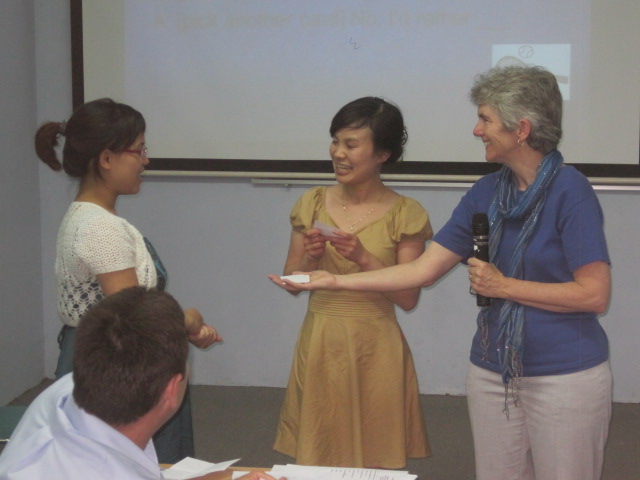
Workshop for teachers at International School, Vietnam National University

Images of Hanoi

A rain shower brings out the ponchos for scooter riders.

The Hanoi Opera House, built in the French colonial era, ~1910.  Two forms of head gear common in Vietnam, the conical bamboo hat, and the motorscooter helmet.  Note the logo on the girl's helmet. No hard feelings about the war for her generation.  Calling and driving?  Why not.


Hoan Kiem Lake, in the center of the old quarter of Hanoi.

Hanoi has lots of lakes and canals.  At the end of May, the flame trees are starting to bloom. New high rise apartments (background) are starting to take over the "traditional" urban three- or four-story narrow buildings.


Sidewalks are for parking motor scooters and for setting up little restaurants.

A sidewalk seafood cafe.

The Huc Bridge, Hoan Kiem Lake, Hanoi--a popular site for local tourists too.
Bustling Hanoi.  The red flags were because of Ho Chi Minh's birthday and an election.

Ha Long Bay, Vietnam


Home again

Around the world in 40 days (for Kitty...30 days for Lee)!  It is remarkable that we visited so many places with so few hassles or snags.  We felt we were living Psalm 23:3, as God guided our paths, and we're very thankful for each of our hosts.  Now that we are back in Pasadena where we can access our blog, we hope you don't mind the long catch up posts.  We'll also try to write a bit about what we are noticing and experiencing back in the U.S.  (And next time we'll do a little research to make sure our hosting site is more accessible as we travel!)

Photos will be coming too! :-)

Vietnam

Wednesday-Thursday, May 18-19
Our first activity in Vietnam was a presentation at Hai Phong University, a two-hour drive from Hanoi.  Our hosts were ELI teachers, including a former student of mine, Ruth; our venue was the American Center there, sponsored by the U.S. Embassy, so the event was the occasion for lots of official networking.  I gave two workshops (critical thinking and student-created practice activities) to a large audience of a few teachers and a lot of students (required to be there?).  We enjoyed dinner with ELI folk, followed by an evening with a few students.  The next morning, Ruth made sure we enjoyed a typical Hai Phong breakfast at a street café: rice-noodle crepes around vegetables and shrimp.  After we got back to Hanoi, we wandered around the old town of Hanoi by Hoan Kiem Lake.  A couple of hours of shopping left us ready for mango shakes in a lakeside café as the evening cooled.

Friday-Saturday-Sunday, May 20-22
A rainy morning made for a good time to stay inside and work on my presentations for Saturday.  More time in old Hanoi in the afternoon.  Evening with Mike Beard, our Hanoi host, for a game night with some of his university students along with his family, teammates, and a group of four American college students visiting Vietnam.

Saturday was an all-day workshop for about six international and twenty local teachers at Vietnam National University, the International School (where Mike teaches).  I gave five different talks,, followed by a Q-A session.  So thankful for health, stamina, and a very responsive audience.  The university treated us to a nice lunch and a wonderful dinner afterwards too.  Vietnamese food is delicious!

On Sunday we went with the Beards to Hanoi International Fellowship in the morning (another great multicultural worship service) and the Museum of Ethnology in the afternoon.  There we saw exhibits about the minority ethnic groups of Vietnam, and also got to watch a water puppet show.  It was also fun to see groups of local college students enjoying themselves there.  That evening a sudden thunderstorm broke the hot weather which had been building up.

Monday – Ha Long Bay, May 23
We were tourists today, taking a tour to the famous spot where more than a thousand vertical islands dot the bay north of Hanoi.  Since Vietnam hasn’t joined China in its road-building craze, the drive on a two-lane road crowded with all kinds of traffic took more than three hours.  Seeing agriculture, industry, and small town life made it worth it.  We were one of seventeen foreigners on one tour boat (with dozens of others) plying the water among the islands, stopping first at a floating fish market (where one can supplement one’s lunch), then at a kayaking dock (fun to paddle in and out of some sea caves), and finally at a place to get out and hike up to a cave (quite spectacular).

Tuesday – last day in Vietnam, May 24
I was able to squeeze in a visit to another language institute, a trip to the big foreign language bookstore to help Mike with some summer materials choices, and a return to IS-VNU to observe some local teachers.

One of the things one immediately notices in Hanoi is the traffic.  The majority of the population ride motor scooters (including Mike and Michelle—so we were often on the back of their bikes).  Shaded by an umbrella, sheltered under a poncho, burdened by all kinds of loads, joined by a friend or couple of kids—the thousands of scooters flow along, interacting with cars and busses in a mutually amicable way. Intersections without lights, u-turns to negotiate multi-lane avenues, or left turns across traffic—all seem crazy—yet we never once saw an accident.  Pedestrians (including us!) learn to cross the streets by walking slowly and predictably so traffic can flow around you.  It seems like a good metaphor for Vietnam—definitely getting to their destination, but in a way that accommodates all kinds (including former enemies, like Americans).

Another thing we noticed is how much life occurs outdoors.  Most sidewalks (if not filled with parked scooters) are filled with small plastic tables and chairs—a little restaurant--or people selling fruit/shoes/scooter helmets/etc.  Parks are filled with people—couples on benches, women doing jazzercise in the cool evening, students hanging out with friends, afficianados with their bird cages…New high rise apartments going up in the suburbs may change that, but for now, the public/private distinction in Vietnam is very different than it is in the U.S.

I loved the enthusiasm and quality of the teachers I met.  We also really appreciated the warmth of the Vietnamese.  Definitely a place to consider returning to.  (And like every where we went, they're eager to get more English teachers...with places for everyone, from a short-term volunteer to a highly-trained professional...)

Tuesday, May 17, 2011

China


We’re sorry that we were unable to access our blog while we were in China.  We have now arrived in Hanoi, Vietnam.  Here’s a summary of our wonderful 12 days across China.

Urumqi (where we spent one day en route from Dushanbe to the rest of China) surprised us both.  Lee had been expecting a Uighur town with a Turkic feel—but found a huge bustling city (of 2 million) where Uighur culture is limited to certain neighborhoods, has been recreated by Chinese in a touristy market square, or lingers simply in food and women’s dress.  Kitty had been wondering how China had changed in the 30 years since she taught there from 1980-82. Urumqi’s modern airport, soaring high rise apartments, busy freeways, and jammed shopping districts made the progress powerfully apparent.  We also appreciated the people we met there: a former student from Biola and her family, and several of their American/British friends.  People are working in a variety of ways there: studying Chinese, teaching English, working in a TexMex restaurant, translating Uighur folk tales, working with local health officials on an HIV/AIDS project, and marketing custom-made guitars from local wood.

Pingliang.  We got to this small town in Gansu province by taking an early-morning flight from Urumqi to Xian followed by a four-hour bus ride.  Kitty’s Chinese began to reappear.  The Chinese countryside revealed some things that hadn’t changed in 30 years (farmers tending apple orchards and wheat fields by hand) and some progress (good interstate roads, solar hot water heaters and satellite dishes on village roofs, and fewer people in the fields since many have gone to the cities to earn more money after planting crops).  Our reason for visiting Pingliang was to see the Oasis Training Center, a ten-year old project which our friends Peter & Ruthie Dutton have recently been asked to help oversee.  It’s a two-year immersion-in-English experience for young people from the countryside and/or the local vocational high school which houses OTC.  We enjoyed meeting the volunteers teaching there and the eager students, observing classes, and considering some of the issues inherent in continuing such a program.  We also got to take a hike to Kong Tong Shan, a Taoist center. Another difference between now and 30 years ago—the number of Chinese tourists and the number of Chinese trying out religious practices. In this small town and relatively poor school I saw more familiar sights from the past, like students going to get hot water in thermoses.

Taiyuan.  Our next stop was a city near where Kitty taught in Shanxi in ‘80-‘82.  Her friend from those days, Gordon Xu, lives there with his wife, daughter, and granddaughter.  We enjoyed dinner together, lots of reminiscing, and insightful conversation about China today from the perspectives of three generations.  --There may be a lot of new roads in China, said Gordon, but “we need to build a super highway to moral excellence.”  “Listen to this—it’s my favorite song from High School Musical,” said his granddaughter.  “Excuse me, I’ve got to go back to work for a bit,” apologized his daughter, an editor for a TV program about Taiyuan traffic.

Beijing.  We had another reunion with four of Kitty’s old friends from Shanxi days, now living in Beijing.  The comfortable three-hour high-speed train ride from Taiyuan to Beijing made us very envious of China.  The taxi ride between the train station and the airport through Beijing’s smog and an incoming dust storm evoked the opposite feelings.  Our afternoon in a beautiful airport coffee shop talking with the two couples, one retired and able to travel all over China, one still working in prominent positions in agriculture and education, was a delight.

Zhangjiajie.  Our time in this pleasant town In Hunan province was facilitated by Beth, a former student of Kitty’s.  Her employer, the Foreign Languages campus of Jishou University, was thrilled to meet the teacher of one of their favorite teachers, and went out of their way to show us incredible hospitality.  Kitty gave a talk on Current Trends attended by many teachers and students (future English teachers and others aiming to use English in business or become Chinese teachers in foreign countries).  She also held a Q-A session with teachers and observed several classes.  She and Lee both participated in Beth’s office hours, where we had a chance to talk with small groups of students.  Lee also met some friends of Beth from Singapore who operate a bakery in town.  

The university got us two-day passes to Wu Ling Yuan, an incredible national park about 45 minutes from the university. We went on both Saturday and Sunday. Imagine the kind of landscape seen in the movie Avatar, or classic Chinese landscape paintings, or Bryce Canyon in green instead of red.  There are dozens of areas within the park, each with views more amazing than the next.  We hiked a lot, but also took advantage of a shuttle bus, giant elevator, and cable car to cover territory. The weather was a bit drizzly, so the views were enhanced with wispy clouds floating around the columns and mountains.

During our five days there we also ate very well.  Whether a simple restaurant outside the university gate that Beth frequents, or one of the several dinners for us hosted by the university, there seemed to be no end to delicious new dishes.  Good reminder of the psalm: “Taste and see that the Lord is good.”  From Beth, staff and students we also got the sense that many people are hungry at many different levels.

Next stop: Vietnam—our last country.  Now that Kitty’s Chinese is thoroughly stirred up, it’s time to go to a completely new place and have a new adventure. J

Wednesday, May 4, 2011

Tajikistan


A week ago Wednesday I was getting a wonderful tour of Muscat, flying to Dubai, and waiting for the Somon Air flight to Dushanbe.  Lee was flying Turkish Air from LA to Istanbul to Dushanbe.  Early Thursday morning I stared out the plane window to see the snow-capped peaks of the Pamirs faint in the dawn.  As I disembarked the plane and got on a bus that took us away from an airport under construction to an old building off in the corner, and filled out duplicate forms by hand for my visa, and saw bulky bundles wrapped in plastic rather than sleek suitcases coming off the luggage conveyor belt, I thought—Tajikistan!  It was great to see Lee and our host J, with his wife P (my former student) and their engaging 9-month-old son T waiting for us at their apartment, our home for the next week.  It was a relief to hang out and rest all day Thursday.  A two-minute rain shower sent us running for the laundry on the line—otherwise it’s been unseasonably hot and dry here, an early summer.  A quick drive around Dushanbe revealed that some things are like Ashgabad, Turkmenistan (where we lived for five months in 1996), like Soviet style architecture and signage, or courtyard style homes (for those not living in high rises) with fig and apricot trees or grape-vine arbors over a platform for evening meals.  Other things are uniquely Dushanbe, like the beautiful tree-lined boulevards and many parks.

One of our main activities here was a TESOL seminar P had organized for about 36 ex-pat teachers and their Tajik colleagues.  I gave two talks/demos on Friday night, two more on Saturday morning, and a final workshop on Saturday afternoon after lunch together.  I was sitting down by the last one, instead of bounding around the room as I often do. J  But it was worth every minute, as teacher after teacher said they had learned something relevant and valuable.

Sunday we had time to rest.  Lee and I took a walk along Rudaki Boulevard, the main street, to the statue of Somon and an incredible view of snow-capped mountains.  Later that day was time to worship together.

Monday was the May 1st holiday (International Worker’s Day) and we headed out of town along the river to Varzob, a little mountain “resort.” There people rent little platforms with rug and cushions, order grilled meat on a skewer, bread, soup, yogurt and lemon tea, and enjoy the noisy rushing water and cool shade.

Somewhere along the way I picked up an intestinal bug (probably because I boasted of having a strong stomach). Sad!  Thankfully, I was still able to do my next seminar on Tuesday.  This was organized by another American colleague, S, who teaches at the Institute for Foreign Languages.  First I met with S’s third-year students, training to be secondary English language teachers.  Then S and I had ice cream in a nice café and got to talk about her experiences here.  Finally, back at the institute, I gave my demonstration again to her English-teacher colleagues.  Many things about the institute reminded me of Turkmenistan!

Lee helped a lot with the Fri/Sat TESOL training, but at other times this week he’s been pursuing his own interests.  J arranged for him to meet people working with various NGOs and businesses here. Creative enterprises abound;  I learned about educational consulting, services to business high rises, business training, crafts, and restaurant and a bakery.

Today has been a nice finale to our time together, with more family time, and a lovely lunch in the Choi Khona Rokhat, a tea house/restaurant.  Fountain, courtyard, balcony, breezes, painted ceiling…  So pleasant!

Through it all we’ve been encouraged on the spiritual level too.  We know better how to give thanks for and how to pray for Tajiks.

--Kitty